
Skip to Content
chevron-left chevron-right chevron-up chevron-right chevron-left arrow-back star phone quote checkbox-checked search wrench info shield play connection mobile coin-dollar spoon-knife ticket pushpin location gift fire feed bubbles home heart calendar price-tag credit-card clock envelop facebook instagram twitter youtube pinterest yelp google reddit linkedin envelope bbb pinterest homeadvisor angies

What Are the Best High Mast Light Manufacturers in China?

China’s high mast lighting sector includes experienced manufacturers, ambitious newcomers, and many factories serving overseas projects. The strongest suppliers do more than offer tall poles and powerful LED fixtures. They prove performance through photometric reports, wind-load calculations, corrosion protection, and documented quality controls.

As lighting engineer James R. Benya has said, “Good lighting begins with the visual task, not the fixture.” This principle matters in stadiums, ports, airports, highways, and industrial yards. A reliable high mast system must illuminate wide areas evenly, reduce glare, withstand harsh weather, and remain serviceable at height. Its value appears on the ground.

Small details matter.

This guide compares leading Chinese manufacturers through practical criteria. These include LED efficiency, pole engineering, galvanized finishes, surge protection, optical design, driver quality, installation support, and warranty response. Factory capacity also matters, but it should not decide the purchase alone. A large showroom can look impressive while after-sales service remains uncertain.

The market is not perfectly transparent. Some product claims require careful verification. Buyers should request samples, test records, project references, and clear delivery terms. Site conditions also change the answer. A coastal terminal needs stronger corrosion resistance than an inland warehouse. A windy highway may require different pole calculations from a sports field.

The manufacturers discussed here are not ranked by advertising volume. They are assessed by evidence, consistency, engineering depth, and real project suitability. No supplier is perfect. That is worth remembering. A thoughtful comparison can still identify dependable partners for safe, efficient, and durable high mast lighting projects.
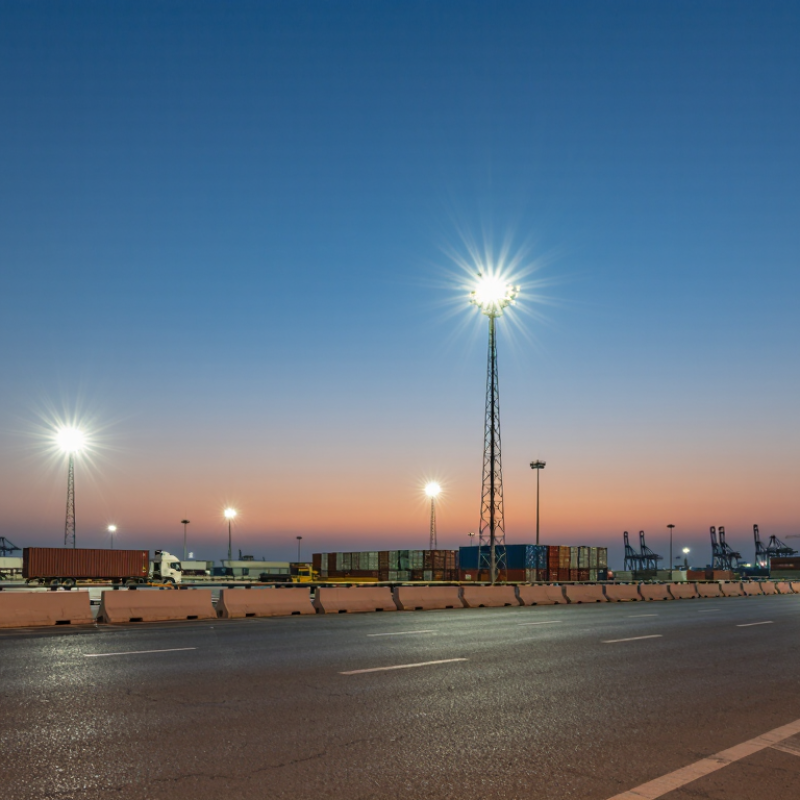
What Are the Best High Mast Light Manufacturers in China?

What Defines a High-Quality High Mast Light Manufacturer in China?

A high-quality high mast light manufacturer begins with practical engineering, not attractive product photos. The manufacturer should understand road layouts, sports fields, ports, and large industrial yards. Each project needs a lighting simulation based on mounting height, beam angle, spacing, and target brightness. Generic designs often create dark areas or uncomfortable glare.

Reliable manufacturers provide structural calculations for the pole, lifting system, foundation, and local wind conditions. They use traceable steel, consistent galvanizing, and controlled welding procedures. Inspectors should be able to check material certificates, weld quality, coating thickness, and electrical performance. Small details matter. A weak door seal can invite moisture. Poor cable routing can complicate maintenance years later.

Experience also appears in the questions a manufacturer asks. Do technicians visit the site? Can they explain installation steps clearly? Do they test LED modules, surge protection, and raising mechanisms before shipment? A dependable supplier keeps inspection records and offers practical replacement guidance. Third-party testing can add confidence, especially for large orders. Still, no factory gets every decision right. I have seen technically strong proposals overlook access for maintenance vehicles. That mistake can increase operating costs. Clear drawings, honest limitations, and responsive after-sales support often reveal more than a polished catalog. The best manufacturers keep improving through field feedback, not just factory claims.

Key Factors for Comparing Chinese High Mast Light Suppliers

Comparing Chinese high mast light suppliers requires more than checking unit prices. Experienced buyers examine the complete lighting system, including poles, luminaires, lifting equipment, controls, and installation support. Ask for photometric files, tested lumen output, beam distribution, and energy data. A supplier that explains these figures clearly usually understands real project conditions.

Manufacturing quality should be visible, not promised. Review aluminum grades, powder-coating thickness, cable protection, and enclosure ratings such as IP65 or higher. Request inspection records for welding, insulation, surge protection, and wind-load calculations.

Factory visits can reveal practical details, like storage conditions and production discipline. Photos are useful, but they can hide weaknesses.

Certification matters.

Check whether test reports come from recognized laboratories and match the exact product model. A sample should operate continuously before a large order is approved. Warranty terms must define coverage, response time, spare parts, and repair responsibility. Delivery history also deserves attention. Ask for references from comparable stadiums, ports, highways, or industrial yards, then verify them independently. I have seen attractive quotations fail because replacement parts were unclear or drawings arrived late. That risk is easy to underestimate. Communication quality matters as much as technical capacity, especially when pole heights, lighting levels, or local safety requirements change during engineering review.

Leading High Mast Light Manufacturers and Their Product Strengths

China’s leading high mast light manufacturers compete through engineering depth, not only low quotations. Experienced factories usually provide photometric simulations, wind-load calculations, and corrosion protection plans before production. Their high mast systems often use galvanized steel poles, lowering sections, and LED floodlights with adjustable beam angles. This matters on ports, highways, logistics yards, and sports grounds. Site details matter.

Stronger manufacturers maintain in-house testing for pole welding, coating adhesion, electrical insulation, and LED thermal performance. They can adapt mast heights, lifting mechanisms, access platforms, and control cabinets to project conditions. A reliable supplier shares drawings, wiring diagrams, installation guidance, and inspection records. Ask for recent project references and measurable data, including delivered lux levels, power consumption, and maintenance intervals. Photos alone prove little. That is worth remembering.

Product strength also appears after delivery. Responsive technical teams keep spare winches, cables, drivers, and sealing components available for scheduled maintenance. Some suppliers support smart controls, timed dimming, and fault alerts, which can reduce nighttime inspections. However, catalog efficiency figures may not match field performance under dust, humidity, or voltage variation. I would request independent test reports and a sample pole inspection before signing. A lower price can hide thinner galvanizing, weaker lifting parts, or limited after-sales support. The best choice is not always the cheapest. It is the manufacturer that documents assumptions, admits limits, and builds for the actual site.

Manufacturing Standards, Certifications, and Quality Control Practices

What Are the Best High Mast Light Manufacturers in China?

Reliable high mast light manufacturers in China demonstrate more than production capacity. They control steel selection, welding, galvanizing, LED assembly, and final inspection through documented procedures. Experienced suppliers usually align products with applicable GB/T and IEC requirements. Export projects may also require CE-related compliance, depending on the destination market.

Look for ISO 9001-certified quality systems, but do not treat certification as proof of perfect products. ISO 9001 confirms process management, not automatic product performance. Ask for material certificates, welding inspection records, galvanizing thickness reports, and wind-load calculations. Independent laboratory reports can verify photometric performance, ingress protection, impact resistance, and electrical safety. These details reveal whether testing is genuine or simply promotional language.

Factory audits add practical evidence. Inspect raw material storage, welding stations, coating areas, and aging-test records. A dependable manufacturer should trace each pole, luminaire, driver, and batch number. Check whether workers measure bolt torque and inspect grounding continuity before shipment. Small details matter.

Mistakes still happen.

Even strong factories may show inconsistent coating thickness or incomplete records during busy seasons. This is where corrective-action reports become important. Ask how defects are isolated, repaired, and prevented from recurring. The best supplier is not necessarily the largest one. It is the manufacturer that can explain its standards clearly, provide verifiable evidence, and accept technical scrutiny without avoiding difficult questions.

What Are the Best High Mast Light Manufacturers in China? - Manufacturing Standards, Certifications, and Quality Control Practices

Evaluation Dimension Applicable Standard or Certification What a Qualified Manufacturer Should Demonstrate Recommended Verification Evidence
Quality management system ISO 9001:2015 / GB/T 19001-2016 Documented control of design, purchasing, production, inspection, nonconforming products, corrective actions, and traceability. Valid certificate issued by an accredited certification body, scope covering lighting equipment or metal structures, and recent audit status.
Environmental management ISO 14001:2015 / GB/T 24001-2016 Controls for chemical use, waste handling, energy consumption, wastewater, packaging, and environmental compliance. Certificate, environmental procedures, waste-disposal records, and applicable regulatory permits.
Occupational health and safety ISO 45001:2018 / GB/T 45001-2020 Risk assessments for welding, galvanizing, machining, lifting, electrical testing, and high-mast assembly. Valid certification, workplace risk assessments, training records, and incident-prevention procedures.
Luminaire safety IEC 60598-1 and IEC 60598-2-3 Protection against electric shock, abnormal operation, mechanical hazards, heat, moisture, and installation-related risks for road and street lighting equipment. Test reports from a competent laboratory, technical construction file, wiring diagrams, and safety test records.
Ingress protection IEC 60529 A clearly specified IP rating for the luminaire enclosure, supported by dust and water ingress testing. Outdoor high-mast luminaires commonly require a high IP rating, but the required level should match the project environment. Laboratory report identifying the exact model, test configuration, date, and achieved IP rating.
Impact resistance IEC 62262 The enclosure and lens should have an impact rating appropriate for exposed outdoor installation, maintenance activity, and local vandalism risks. Impact-test report stating the IK level and tested product configuration.
Photometric performance IES LM-79-19 or an equivalent recognized photometric test method Measured lumen output, power consumption, luminous efficacy, color characteristics, and distribution data should be based on a complete luminaire rather than only the LED package. Independent photometric report, IES/LDT files, product datasheet, and comparison between rated and measured values.
LED lifetime and lumen maintenance IES LM-80-21 and TM-21-21 principles Lifetime claims should be supported by LED package test data, temperature measurements, drive current, thermal design, and a stated lumen-maintenance projection method. LM-80 data, TM-21 projection, in-situ temperature measurement, driver specifications, and warranty conditions.
Electromagnetic compatibility IEC 61547, IEC 61000-3-2, and IEC 61000-3-3, as applicable The luminaire should limit electromagnetic emissions and demonstrate immunity to relevant disturbances in the intended installation environment. EMC test report covering the exact model, rated input, operating mode, and applicable limits.
Surge protection IEC 61000-4-5 test principles and project-specific electrical requirements Outdoor luminaires should include a documented surge-protection strategy, coordinated with the power system and local lightning conditions. Surge test results, protection-device specifications, wiring diagrams, replaceability information, and grounding instructions.
Steel mast structural design Applicable national structural codes, EN 40 where relevant, and project wind-load requirements Pole dimensions, plate thickness, weld design, foundation loads, access system, door arrangement, and wind-load calculations should be engineered for the installation site. Stamped structural calculations, shop drawings, material certificates, weld procedures, and foundation-load data.
Welding quality ISO 3834 principles and applicable welding codes Controlled welding procedures, qualified operators, suitable filler materials, dimensional checks, and inspection of critical welds. Welding procedure specifications, welder qualifications, inspection reports, and non-destructive testing records where required.
Corrosion protection ISO 1461 or ASTM A123/A123M for hot-dip galvanized steel, as specified by contract The coating process should provide consistent zinc coverage, adequate adhesion, drainage and venting, and controlled repair of damaged areas. Galvanizing certificate, coating-thickness measurements, visual inspection records, repair procedure, and surface-preparation records.
Material traceability Quality-management and contract-specific traceability requirements Steel grades, LED modules, drivers, surge protectors, fasteners, and coatings should be traceable from incoming inspection through final shipment. Mill certificates, incoming inspection records, batch numbers, production records, and packing-list references.
Factory quality control Documented inspection and test plan Incoming-material inspection, in-process dimensional checks, electrical safety tests, functional testing, visual inspection, and final packing verification. Inspection and test plan, calibrated-equipment records, first-article inspection, final inspection reports, and nonconformance statistics.
Testing and calibration capability ISO/IEC 17025 for competent testing laboratories Internal laboratories or external partners should use calibrated equipment and controlled test methods relevant to electrical, photometric, thermal, and mechanical performance. Calibration certificates, laboratory scope, equipment-maintenance logs, test-method references, and independent verification reports.
After-sales and warranty control Contract warranty terms and documented corrective-action procedures Clear warranty exclusions, spare-parts availability, failure-analysis procedures, response times, and a process for handling recurring field failures. Written warranty, service-level commitments, spare-parts list, failure-rate records, and sample corrective-action reports.

How to Select the Right Chinese High Mast Lighting Partner

Selecting the right Chinese high mast lighting partner requires more than comparing unit prices. It requires evidence. The IEA’s Energy Efficiency 2023 report estimates that lighting consumes about 15% of global electricity use. Efficient high mast systems can therefore reduce long-term operating costs. Ask manufacturers for verified lumen output, power consumption, beam distribution, and maintenance plans. Request recent project records, not only polished brochures. Real installations reveal more.

Technical due diligence matters. Check compliance with IEC 60598 requirements, appropriate IP and IK ratings, wind-load calculations, corrosion protection, and thermal testing. Request IES or LDT photometric files for independent simulation. The U.S. Department of Energy’s 2022 Solid-State Lighting R&D Opportunities report highlights efficacy, reliability, and controllability as key development priorities. These points should guide supplier evaluation. A factory audit can confirm driver testing, aging procedures, traceability, and production capacity. A low quotation may hide weak surge protection or limited spare parts.

Tips: Start with a paid sample and a written specification. Test it at the planned pole height. Review light uniformity, glare, temperature, and installation time. Confirm warranty exclusions, replacement procedures, and response times. Use an independent inspection before shipment. Communication quality is also evidence. If answers remain vague, pause. Even experienced buyers can overlook installation risks when schedules become tight.

What Are the Best High Mast Light Manufacturers in China?

How to Select the Right Chinese High Mast Lighting Partner

How to read this chart: These are practical reference targets for evaluating high mast lighting suppliers, rather than data from any individual company. A qualified partner should be able to provide documented performance for system efficacy, service life, ingress protection, impact protection, and warranty coverage. Verify each figure through test reports, technical datasheets, and contract terms.
Reference framework: IEC 60529 for IP ratings, IEC 62262 for IK ratings, and commonly specified public-lighting procurement requirements.

Article Source: