
2026 Top Solar Panel Gasket Types for Global Buyers
As solar projects expand across rooftops, farms, and coastal installations, gasket selection deserves more attention. In 2026, global buyers must evaluate more than price and availability. A Solar Panel Gasket helps seal module frames, junction areas, and mounting interfaces against water, dust, vibration, and thermal movement. Small sealing failures can create large maintenance costs.
This guide introduces the leading gasket types used in modern photovoltaic systems. It compares EPDM, silicone, neoprene, rubber foam, and custom molded profiles. Each material behaves differently under ultraviolet exposure, temperature changes, compression, and humidity. EPDM often suits outdoor environments because of its weather resistance. Silicone remains valuable where wide temperature performance matters. However, neither material is automatically the best choice. Local climate decides much of the result.
Look closely at details. A gasket may appear secure but lose pressure after repeated heating and cooling. A profile may fit one frame perfectly yet deform on another. Buyers should review hardness, compression set, dimensional tolerance, adhesive compatibility, and service temperature. Product drawings and test reports provide stronger evidence than marketing claims. Supplier experience also matters, especially for projects crossing multiple climates and manufacturing standards. Ask for samples.
There is no universal winner. Some decisions remain uncertain until real installation conditions are tested. Reliable procurement combines laboratory data, field experience, traceable materials, and clear quality controls. This overview supports a practical comparison, but engineers should confirm every selection with the module manufacturer and project specifications. Small components still deserve serious engineering.
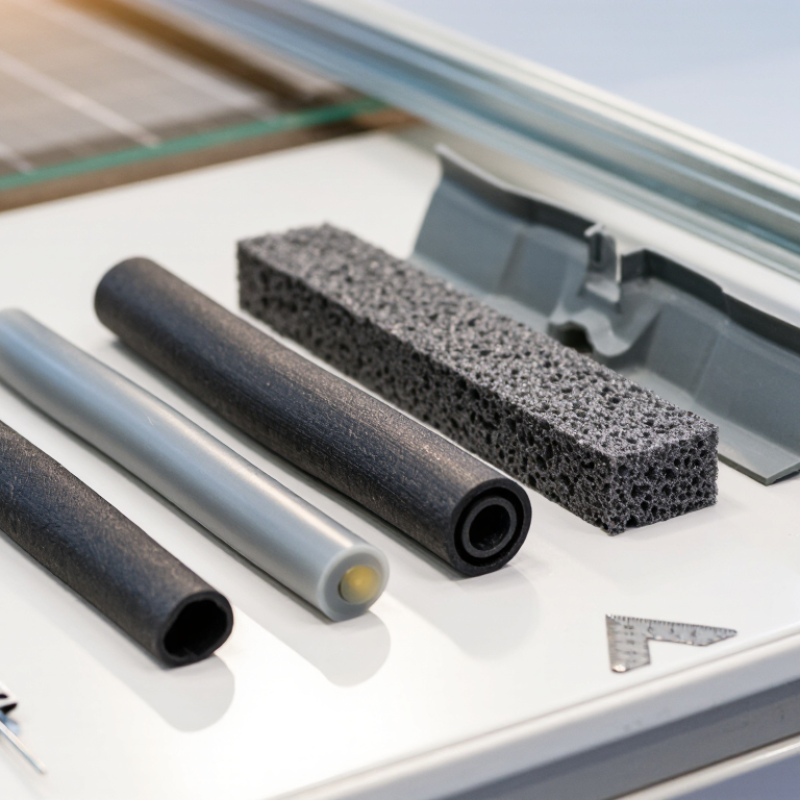
What Solar Panel Gaskets Are and Why They Matter
A solar panel gasket is a flexible sealing component placed between the module frame, glass, junction box, or cable entry. It closes narrow gaps where water, dust, and air could enter. Common gasket materials include silicone, EPDM, and butyl rubber. Each behaves differently under ultraviolet exposure, heat, compression, and repeated expansion.
The need is growing quickly. The IEA PVPS Trends in Photovoltaic Applications 2024 report recorded approximately 456 GW of new photovoltaic capacity in 2023. Cumulative global capacity exceeded 1.6 TW. Every module represents another sealing surface exposed to weather. A small edge gap can collect moisture after rain. Later, thermal expansion may widen it.
Good gasket selection depends on the installation environment. Silicone usually offers strong weather resistance and stable flexibility. EPDM performs well against ozone and outdoor aging. Butyl materials can provide effective moisture barriers, but their long-term behavior needs careful testing.
Buyers should review compression set, tensile strength, water absorption, and temperature limits. IEC 61215 and IEC 61730 testing also support module safety and durability evaluations.
A gasket is not glamorous. That may be the point. It should maintain contact without excessive pressure on the glass or frame. Yet specifications can mislead when laboratory conditions differ from rooftops. The NREL PV Lifetime Project has documented how heat, moisture, ultraviolet radiation, and mechanical stress influence photovoltaic reliability. Ask for test evidence, production tolerances, and field experience, not only a material name.
How Major Solar Panel Gasket Types Differ
Solar panel gaskets differ mainly in elasticity, weather resistance, installation tolerance, and long-term compression behavior. Silicone gaskets tolerate wide temperature swings and resist ultraviolet exposure well, making them suitable for exposed module edges. However, silicone can tear during fitting and may absorb dust on poorly finished surfaces. EPDM offers strong resistance to ozone, water, and outdoor aging. It is often less expensive, but its performance depends heavily on the compound grade and compression design. TPE and TPV gaskets provide easier processing and useful recyclability advantages, although their heat and UV performance must be verified carefully.
The IEA PVPS Trends 2024 report estimated that global photovoltaic capacity exceeded 1,600 GW after approximately 456 GW of additions in 2023. This expansion increases demand for reliable sealing materials, especially in humid, desert, and high-altitude projects. Field engineers should compare compression set, tensile strength, elongation, water absorption, and temperature aging results. IEC 61215 testing evaluates module durability, but it does not make every gasket suitable for every climate. That distinction matters.
Small details matter.
A gasket with poor corner fit can create a narrow leak path, even when laboratory samples pass inspection. Experience from module assembly also shows that excessive compression may distort frames and increase installation stress. Buyers should request batch traceability, accelerated-aging data, and dimensional inspection records. ASTM or ISO test methods can support comparison, but test conditions rarely reproduce every rooftop or utility-scale environment. A cheaper TPE profile may perform well in mild climates, yet silicone or qualified EPDM could offer greater confidence under severe solar exposure. The correct choice remains application-specific, and supplier data deserves independent review.
2026 Top Solar Panel Gasket Types for Global Buyers - How Major Solar Panel Gasket Types Differ
| Gasket Type | Typical Solar Panel Location | Typical Service Temperature Range1 | UV and Weather Resistance | Main Advantages | Main Limitations | Typical Buyer Applications | Key Inspection Points |
|---|---|---|---|---|---|---|---|
| EPDM Rubber Gasket | Module frame perimeter, mounting interfaces, junction-box sealing in selected designs | Approximately −40°C to +120°C; formulation and compression design affect the actual rating | Very good resistance to sunlight, ozone, rain, and humidity | Good long-term outdoor durability; cost-effective; flexible; widely available; suitable for many static seals | Not recommended for continuous contact with petroleum-based oils, fuels, or many hydrocarbon fluids | Framed modules, rooftop systems, utility-scale projects, and general outdoor PV sealing | Compression set, dimensional tolerance, joint design, surface finish, hardness, and resistance to water ingress |
| Silicone Rubber Gasket | Junction boxes, cable exits, connectors, frame seals, and high-temperature sealing locations | Commonly approximately −50°C to +200°C, depending on grade and design | Excellent resistance to UV radiation, ozone, moisture, and temperature cycling | Wide temperature capability; strong aging performance; remains flexible over a broad temperature range; good electrical insulation | Usually higher cost; relatively lower tear and abrasion resistance than many organic rubbers; may have higher gas permeability | Hot climates, cold climates, high-reliability junction boxes, and components exposed to thermal cycling | Grade suitability, compression set at operating temperature, tear strength, adhesion compatibility, and electrical insulation properties |
| TPE or TPV Gasket | Co-extruded frame seals, snap-fit channels, replaceable perimeter gaskets, and customized profiles | Typically approximately −40°C to +100°C or higher, depending on polymer family | Good to very good when a UV-stabilized outdoor grade is selected | Can be extruded or molded; recyclable in some production systems; consistent dimensions; easy installation; supports complex profiles | Performance varies significantly by formulation; some grades show creep or compression set under prolonged heat and load | High-volume module production, lightweight profiles, automated assembly, and applications requiring custom geometry | Outdoor UV rating, compression set, creep resistance, profile dimensional stability, weld or corner quality, and recyclability claims |
| Neoprene (CR) Gasket | Electrical enclosures, junction-box seals, cable-entry seals, and selected frame applications | Approximately −35°C to +100°C for many general-purpose grades | Good resistance to weathering, ozone, and moderate sunlight exposure | Balanced mechanical strength; good resistance to abrasion and moderate oils; useful for rugged enclosure seals | Generally less resistant to long-term heat and UV aging than high-grade silicone or EPDM; material selection must match the exposure | Robust electrical enclosures, mechanical protection areas, and installations with moderate oil or abrasion exposure | Actual weathering grade, plasticizer migration, compression set, oil compatibility, and long-term outdoor test results |
| Fluorosilicone Gasket | Specialized junction boxes, connectors, and seals exposed to fuels, oils, or aggressive fluids | Often approximately −60°C to +175°C, depending on grade | Excellent UV, ozone, and weathering resistance | Combines broad silicone temperature performance with improved resistance to many fuels and hydrocarbon-based fluids | High material cost; limited need for ordinary PV environments; mechanical strength may require careful design | Specialized PV equipment near industrial fluids, transport applications, or demanding chemical environments | Chemical compatibility, compression set, fluid immersion results, temperature cycling, and justification for the premium material |
| Polyurethane (PU) Gasket | Protective enclosure seals, cushioning interfaces, and selected custom-molded applications | Commonly approximately −40°C to +90°C; grade-specific limits are important | Variable; outdoor use generally requires a UV-stabilized aliphatic grade rather than a standard aromatic grade | High abrasion resistance; good tear strength; available in solid and foam forms; useful for cushioning and impact protection | Some formulations hydrolyze or discolor under heat, moisture, and sunlight; not every PU grade is suitable for long-term outdoor PV use | Protected enclosures, impact-prone areas, and custom seals where abrasion resistance is more important than maximum temperature capability | UV-stabilizer type, hydrolysis resistance, water absorption, compression recovery, and accelerated aging performance |
| Foam Tape or Closed-Cell Foam Gasket | Low-pressure frame interfaces, enclosure covers, cable-entry interfaces, and secondary weather seals | Typically approximately −40°C to +90°C, depending on foam chemistry and adhesive system | Good when the foam, adhesive, and facing are all rated for outdoor exposure | Fast installation; conforms to uneven surfaces; provides cushioning and vibration isolation; available in various thicknesses | Usually lower resistance to sustained compression, peel forces, solvents, and extreme temperatures than solid rubber seals | Secondary sealing, low-pressure weather barriers, and assemblies with moderate dimensional variation | Closed-cell structure, water absorption, adhesive shear strength, compression recovery, edge sealing, and exposure to condensation |
1 Actual operating limits must be confirmed with the material specification and the complete gasket assembly design.
Which Materials Suit Different Solar Panel Environments
2026 Top Solar Panel Gasket Types for Global Buyers
Which Materials Suit Different Solar Panel Environments
Solar panels now operate in harsher locations than many buyers expect. Global photovoltaic capacity exceeded 1.6 terawatts in 2023, according to IEA PVPS Trends 2024. More installations also mean more exposure to salt mist, heat, humidity, and dust. Gaskets protect the module frame, junction areas, and cable entries from moisture. Small sealing failures can create expensive field problems.
Silicone gaskets suit deserts and tropical regions because they tolerate ultraviolet radiation and wide temperature changes. Their flexibility helps absorb frame movement during daily heating and cooling. EPDM performs well against ozone, rain, and general outdoor ageing. It is often practical for temperate and coastal projects. But EPDM is not ideal for every oil-contact application. That detail is easy to overlook.
Butyl rubber provides strong moisture resistance and low gas permeability, making it useful where condensation is a major concern. Fluoroelastomers can handle aggressive chemicals and severe heat, although their higher cost needs technical justification. NREL research reports a median photovoltaic degradation rate near 0.5% per year, yet gasket deterioration can accelerate local damage before performance data reveal it. IEC 61215 and IEC 61730 testing should guide material selection, but laboratory results cannot fully reproduce every coastline or rooftop. Real projects need climate-specific validation.
How to Select Gaskets for Global Solar Projects
2026 Top Solar Panel Gasket Types for Global Buyers
How to Select Gaskets for Global Solar Projects
Selecting a gasket starts with the installation environment, not the product catalogue. A rooftop array in Dubai faces heat, dust, and intense ultraviolet exposure. A coastal project needs stronger resistance to salt, moisture, and ozone. Cold regions demand flexibility during repeated freezing and thawing.
EPDM suits many outdoor sealing applications because it resists weathering and ozone. Silicone performs well across wide temperature ranges and remains flexible after long exposure. Butyl offers strong moisture resistance, while closed-cell foam can help absorb small surface irregularities. The correct choice depends on compression, groove design, frame material, and expected movement. Measure carefully. A gasket that is too thick may distort the frame.
Experienced project teams request test data for compression set, tensile strength, water ingress, UV aging, and thermal cycling. They also check batch traceability and installation instructions. Field conditions often differ from laboratory conditions. Dust on the sealing surface can create a narrow leakage path. Uneven torque can cause early deformation. This is where many specifications become too optimistic.
Small details matter. Check the gasket after installation. Look for gaps, twisting, or permanent flattening. Keep sample records from each production batch. Regional climate data should guide material selection, while local engineering review should confirm the final design. No single gasket type fits every global solar project.
What Buyers Should Check Before Ordering Gaskets
2026 Top Solar Panel Gasket Types for Global Buyers
Global solar expansion makes gasket selection less forgiving. The IEA PVPS Trends 2024 report recorded about 446 GW of new photovoltaic capacity in 2023, lifting global capacity above 1.6 TW. Every seal now faces greater exposure to heat, moisture, ultraviolet radiation, and transport stress. Buyers should compare silicone, EPDM, butyl, and closed-cell foam gaskets by application, not popularity.
Before ordering, request material certificates, compression-set data, UV-aging results, and thermal-cycling evidence. Check whether the gasket matches the module frame, glass, backsheet, and adhesive system. IEC 61215 and IEC 61730 test compliance supports module safety, but it does not automatically prove long-term gasket performance. Ask for dimensional tolerances, hardness, density, and batch traceability. A small mismatch can create a visible pressure line or a hidden moisture path.
Tips: Order production-grade samples, not only catalog pieces. Measure width, thickness, corner radius, and compression after assembly. Review results from independent laboratories where possible. The NREL PV Module Reliability Scorecard repeatedly emphasizes environmental stress and degradation risks. Cheap gaskets may still pass an initial inspection. That is the uncomfortable part. Recheck aging data, because one supplier’s “weather-resistant” claim may mean very little without test conditions, duration, and failure limits.
2026 Top Solar Panel Gasket Types for Global Buyers
Typical continuous service-temperature ranges provide an initial material-screening reference. Actual performance depends on formulation, profile design, compression, exposure, and installation conditions.
What buyers should check before ordering: confirm UV and ozone resistance, compression set, water absorption, material compatibility with glass and frame coatings, dimensional tolerances, hardness, profile consistency, operating-temperature requirements, documentation, and independent test results for the intended climate and installation method.